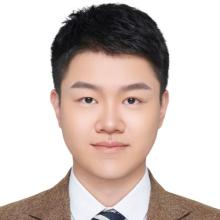
Weichang Lin, PhD Student in Physics, has been fascinated by the mysteries of the universe since childhood. When he learned math and physics could reveal the secrets behind the movement of the planets, he committed to understanding the fundamentals of science to answer the large questions about the universe. Weichang attended Rose-Hulman Institute of Technology as a Physics major with minors in Astronomy and Mathematics. Mentored by a former NASA scientist he became immersed in the scientific culture of critical thinking, problem solving, and data analysis. He interned summers at Southern University of Science and Technology in China where he learned the fundamentals of density functional theory and gained experience using computational methods as he studied material properties. An assignment to estimate the semiconductor bandgap by measuring the junction voltage as a function of temperature and extrapolating the results to absolute zero led to numerous practical challenges and influenced his approach to scientific inquiry. Collaborative problem solving led to his designing a simple component that helped the diode reach thermal equilibrium with its surroundings, ultimately resulting in a fruitful experiment. Engaging in the process of searching the literature, developing appropriate models, conducting an experiment and delving into topics like optics, solid-state physics, mechanics, and electrodynamics, Weichang cultivated a desire to find practical applications for his work beyond the theoretical. He attended Columbia University to obtain a master’s in Physics.
In pursuit of a PhD, Weichang was attracted to RPI’s Physics department because of its strong combination of fundamental science and applications in semiconductor technology. Eager to apply the skills he had developed in computational physics to experimental research, he was particularly interested in working with Professor Gwo-Ching Wang and Professor Toh-Ming Lu, who have extensive expertise in electron diffraction, surface physics, and thin-film materials. “From my perspective,” says Weichang, “combining computation and experiment provides a more complete understanding of scientific problems.”
Currently, Weichang’s work is being supported by the Future of Computing Research Collaboration, a multi-year joint partnership between RPI and IBM addressing practical challenges in the industry. Weichang is focused on developing a new method for measuring the smoothness of material surfaces. In this method, he uses an electron gun to direct a beam of electrons onto a sample. When the electrons reach the surface, they are scattered by the atoms. By analyzing the resulting scattering pattern, he can determine statistical properties of the surface, including its roughness and the characteristic size of its surface features. This technique offers several important advantages: it is highly sensitive to the surface, has sub-nanometer sensitivity to surface roughness, covers a relatively large area, non-destructive, and provides fast measurements in real time. As electronic devices become smaller and more complex, surface smoothness of wafers becomes increasingly important for hybrid bonding, which allows high density chips to be connected and stacked in three dimensions. Conventional surface-measurement techniques are often limited because they involve tradeoffs among measurement area, speed, and sensitivity to extremely small variations in surface height. This technique has the potential to provide a fast, sensitive, non-destructive, and large-area method for evaluating these surfaces.
Weichang is totally immersed in this work and he states, “My research is primarily experimental, and I have gained extensive experience in surface and materials characterization using techniques such as reflection high-energy electron diffraction, atomic force microscopy, X-ray diffraction, Raman spectroscopy, and X-ray photoelectron spectroscopy. Combining experiments with computation has become an important part of how I approach research problems.”
Weichang has extended his work beyond the lab, presenting at the 2026 IEEE Electronic Components and Technology Conference (supported by an ECTC travel grant), has been part of multiple publications, and filed a patent related to electron-based surface-roughness measurement. The Physics department has recognized his work as he has earned the Paul S. Ho ’65 Award in 2025 and the Hillard B. Huntington Award in 2026 for outstanding Physics student.
Outside of the lab, Weichang spends his time playing and modifying role-playing video games. He has recently developed a custom gameplay system for “Monster Hunter: Rise” which randomizes game elements, producing unexpected and entertaining challenges. Post-PhD Weichang expects to continue his semiconductor research in either an industry or academic setting.