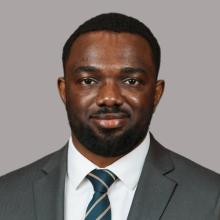
Congratulations to Steve, who received a Department of Energy Office of Science Graduate Research opportunity to work with mentoring scientists at the Los Alamos National Laboratory summer and fall of 2026!
Steve Eshiemogie is a chemical engineering PhD student developing a chemo-biological process that transforms polystyrene plastic waste into high-value biopolymers. In simple terms, he is exploring how to take a non-biodegradable material like styrofoam, break it down into smaller molecules using chemical methods, and then use engineered bacteria to convert those molecules into useful biodegradable products. “What excites me most,” says Steve, “is the potential to turn a global environmental problem into a sustainable resource. This work could benefit industries looking for eco-friendly materials and communities struggling with plastic pollution on a global scale.”
Steve grew up in a remote village in Northern Nigeria and witnessed firsthand the effects of living without access to electricity and clean water. A pivotal moment in his journey was a Christmas holiday spent playing video games with his cousins in Lagos, Nigeria. It left him with questions about why his village had no electricity.
During his undergraduate studies in Chemical Engineering at the University of Benin, Steve developed a strong foundation in process design and reaction engineering. Fascinated by the many potential solutions to challenges in rural sub-Saharan Africa, Steve considered focusing on high-energy-density batteries and working in the energy field. Ultimately, he realized how bio-waste materials could be converted to energy-rich fuels and became inclined to focus on the development of biofuels for alternative energy generation and waste management. His long-term objectives are to develop waste-to-energy solutions that can be deployed to improve living conditions in sub-Saharan Africa.
While at the University of Benin, Steve participated in two UK funded projects. ACTUATE focused on the bioconversion of food waste into biomethane. The result of the project was the design of the first ever biomethane production plant at the University of Benin. The UK RECIRCULATE project focused on wastewater treatment for a circular water economy. Although this research required long and devoted hours, Steve managed to academically excel and earned First Class Honours in Chemical Engineering.
Beyond the research and his academic study, Steve was active in student life on and beyond the campus. He worked with his advisor on a study to understand the perception of Nigerian engineering students towards clean and sustainable energy. This study led to a publication. Steve became Vice-president of the Nigerian Society of Chemical Engineering students and founded an energy and environmental sustainability club for students know as the “Green Africa Initiative.” The group organized climate change and alternative energy awareness exercises for multiple local communities. They also designed and deployed locally fabricated mini biowaste-to-biomethane digester plants to rural communities in Edo State, Nigeria. As a result of these efforts, the Green Africa Initiative emerged as national winner of the renowned L.E.A.P Africa’s Youth Leadership and Community Change Project Competition, and earned recognition from Lancaster University in the U.K.
In considering his graduate school choices, the interdisciplinary and innovative focus of RPI is what attracted Steve. Our chemical engineering department has expertise in metabolic engineering and sustainable materials, providing the perfect environment for his research goals. Steve has greatly impressed his advisor, Professor Mattheos Koffas, who says, “Steve has demonstrated exceptional creativity and determination in tackling one of the world’s most pressing environmental challenges: plastic waste. His work at RPI on converting polystyrene into high-value biopolymers is not only scientifically rigorous but also visionary in its potential to transform waste into sustainable resources. I have been impressed with his ability to bridge chemical and biological methods, and with the clarity of purpose he brings to connecting his research to global impact."
After graduation, Steve plans to work in industry developing sustainable technologies for large-scale environmental impact, with the long-term goal of starting a company focused on converting waste materials into valuable products. In that setting, he envisions leading research and development efforts, bridging the gap between lab-scale innovation and commercial-scale application.
Outside of research, Steve enjoys creative pursuits like drawing and painting, which allow him to express ideas visually in a way that science sometimes can’t capture. He also passionate about youth empowerment and education, and enjoys working on projects that inspire and motivate young people.