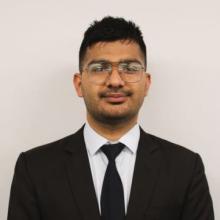
Safal Pathak witnessed firsthand the devastating consequences of a catastrophic Gorkha earthquake as a teenager in Nepal. Living in Kathmandu, one of the regions most affected by the event, he saw how entire communities experienced profound loss of life, property, and history. The long-term impact for Safal was a motivation to prevent such future destruction through civil engineering solutions.
Safal completed his undergraduate studies at Kathmandu Engineering College, where he demonstrated strong performance and early leadership in structural engineering. Safal was a top student, participating in various projects and earning scholarships for six semesters. Of the 1500 students in the prestigious Tribhuvan University, Safal graduated fourth in class, an astounding accomplishment.
In addition to his coursework, he enjoyed many extracurricular activities. He and a team entered a scaled model of the Hoover Dam and the Mike O’Callaghan-Pat Tillman Memorial Bridge into two separate contests, earning 1st position in both. He developed a strong appreciation for civil engineering in the U.S. as he contemplated the marvel of the Hoover Dam and its socio-economic impact 100 years ago. For the first time, he considered a graduate degree in the U.S. Safal realized, however, that his professional journey should include real world experience in the field prior to graduate school. Accordingly, he worked as an engineer in Pumori Engineering Services, where he was a part of teams responsible for the design of 6-8 story residential and commercial buildings exceeding 10,000 square feet. In this role, Safal delivered technical presentations to the structural and geotechnical experts of Kathmandu municipality as part of the formal approval process. This process immersed him in designing, drawing, estimating, and analysis, increasing his understanding of complex projects. These approved projects are now in the construction phase. This industrial experience was invaluable.
Safal was invited by the Civil Engineering Committee as a guest lecturer to speak on C-programming and Civil 3D during his undergraduate program. He became very interested in teaching and while working as an engineer post-bachelors, he also taught multiple undergraduate courses at Himalaya College as an assistant lecturer. Ready to explore further ways to contribute to the structural engineering field, Safal applied to RPI’s civil engineering master’s program, attracted by the work of Professor Michael Symans and the RPI Center for Earthquake Engineering Simulation (CEES), a part of the NSF Network for Earthquake Engineering Simulation.
For his master’s thesis, Safal completed the first probabilistic fragility-based study of multi-story wood-frame buildings with soft and weak ground floors comparing 2 retrofit strategies: one involving viscous fluid dampers and one with steel moment frame retrofit solutions. Using nonlinear response history analysis and fragility assessment, one of the key findings of his work was that strategic placement of a limited number of viscous dampers in upper stories can substantially decrease the probability of collapse under severe earthquake shaking. Given that wood-frame construction represents a dominant structural system for residential and low-rise commercial buildings in the U.S. and is particularly vulnerable to seismic damage, this work contributes to improved performance-based seismic retrofit for such structures. His master’s degree was conferred August 2025 with a perfect 4.0 GPA. During this time, he was very pleased to be awarded a Student Scholarship from the American Society of Civil Engineers, which provided funding for him to attend Structures Congress 2025 in Phoenix, Arizona.
Since spring 2025, Safal has been collaborating with Prof. Min Li from the CEE department on developing a novel framework for prioritizing bridge retrofits in large-scale transportation networks for pre-disaster seismic risk mitigation. The objective of this research is to leverage Graph Neural Networks to identify the optimal set of vulnerable bridges to retrofit to minimize seismic risk under budget constraints. He successfully presented this work in a podium session at the Engineering Mechanics Institute (EMI 2025) Conference held in Anaheim, California, during the summer of 2025 and a soon to be a submitted publication. Building on this research direction, Safal is currently pursuing his Ph.D. at RPI, focusing on uncertainty quantification and machine learning methodologies for enhancing the seismic resilience of critical infrastructure systems.
Safal is as passionate about teaching as he is about his research. He served as a substitute lecturer for two semesters in Professor Michael Symans’s graduate-level course on Structural Dynamics. He lights up when sharing stories of teaching experiences and enthusiastically anticipates seeking an academic teaching position once he completes his Ph.D.
In his spare time, Safal is, “drawn to the quiet intensity of life on the trail.” He has crossed two of Nepal’s renowned high passes: Larke La, a ten-day journey that winds past glacier-fed valleys before an ascent over wind-scoured ice, and Thorong La, an eight-day traverse across yak pastures and alpine ridges. “There is a unique clarity that comes from walking for days through thin air and cold mornings, carrying only what you need, and existence shared with friends and strangers alike in remote, breathtaking landscapes. These experiences have taught me the value of deliberate pacing, the respect one should have for the inherent risks in nature, and the joy one can find from engaging in a simple activity such as trekking.”