1. Tell us about your research focus, how you became interested in it, and who will benefit from what you are doing in the long run.
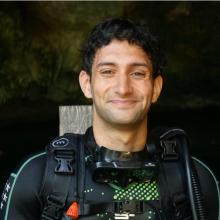
I'm a first-year Chemical Engineering PhD student in Frances Arnold's lab at Caltech. Before this, I earned my BS in Chemical Engineering at Rensselaer Polytechnic Institute, where I worked in Jonathan Dordick's lab building a protease biosensor. That project was where it clicked for me. Once I saw how much you could get a protein to do by engineering it, I realized how powerful protein engineering could be across a wide range of applications, from biosensors to biotherapeutics, and that pulled me toward where I am now.
Enzymes are the catalysts nature uses to run chemistry. They build and break molecules with a precision and efficiency that human chemists struggle to match, and they do it in water, at room temperature, without the rare metals and harsh conditions industrial synthesis usually requires. The problem is that evolution only built enzymes for the reactions life happened to need, so a lot of the chemistry we care about, like the reactions used to make medicines and materials, has no natural enzyme to do it.
The Arnold lab pioneered directed evolution, which won the 2018 Nobel Prize in Chemistry. Instead of designing an enzyme from scratch, you mutate it and let the best-performing variants replicate, creating new catalysts in the lab. The catch is that this search is slow and mostly blind: there are vastly more possible protein sequences than anyone could ever test. My work sits at the interface of computation and the lab bench. I build machine learning models that learn from experimental data to predict which enzyme variants are worth making, and then I make and test those variants myself, feeding the results back into the algorithm to sharpen the next round of designs. Closing that loop, rather than handing predictions off to someone else, is what lets the models actually get better and the engineering get faster.
In the long run, the people who benefit are anyone downstream of how we make molecules and medicines. Better-designed enzymes mean cleaner and cheaper drug production, sustainable synthesis that replaces wasteful petroleum and metal-heavy processes, and a design loop fast enough that a lab can build a custom protein for the problem it cares about instead of waiting on nature to provide one.
2. What is your vision for your future? What do you expect to be doing after your fellowship/graduate degree?
The future I am working toward is one where you can press a button and get the perfect enzyme for whatever chemical transformation you need. That's the north star: protein design reliable enough that building a custom catalyst becomes routine rather than a years-long campaign. Getting there is both a deep technical problem and, eventually, something that has to be built into the world to matter, which is why I want to work at the interface of R&D and leadership. The PhD is where I build the technical depth to earn that, and engineered enzymes paired with AI-driven protein design feel like one of the places where the next decade of useful chemistry and biology will actually get decided. Whether that ends up being in industry, founding something, or leading research, the throughline is the same: I want to be close enough to the science to push the frontier and close enough to leadership to make sure it gets built.
3. What do you anticipate the most about your fellowship experience? Why did you choose the program you applied to?
The benefit I anticipate most from the fellowship is agency over the direction of my research. Because the funding follows me rather than a specific grant, I can chase the high-risk, high-reward questions I think matter most without being tied to someone else's predefined deliverables. That kind of freedom is usually where the most original work comes from.
I chose Caltech and the Arnold lab on purpose. My project only works if I can combine two things that rarely live under one roof: the wet-lab machinery of directed evolution and the modern AI tools for protein design. The Arnold lab supports both directly, so I have mentorship in exactly the areas my research has to bridge rather than having to teach myself one half in isolation. It is also where directed evolution was invented and where a lot of the current generative-AI work on proteins is happening. That overlap is the whole bet of my research, and it is a big part of why the environment matters as much as the funding.
4. What advice do you give to current students considering applying to competitive programs?
Be specific and be memorable. Reviewers are funding people, not just projects, so give them a reason to remember you. State your goals plainly and show that you can turn a setback into a result, because the ability to learn from failure is a lot of what they are actually investing in.
For NSF specifically, two things are important. First, do not treat broader impacts as an afterthought. It is weighted as heavily as the science and most applicants underinvest in it. Second, make the case that your environment will actually support the researcher you are trying to become. NSF is not just betting on you, it is betting on whether you will be mentored and supported in the things you say you want to explore, so show that the fit is real and not an accident. Beyond that: start early, get your statements read by people who have already won, and do not be modest. If you do not make your own case clearly, nobody is going to make it for you.