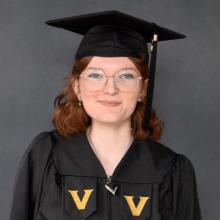
Katie Sullivan received the National Science Foundation Graduate Research Fellowship this fall, recognizing her potential to make an impact in STEM and STEM education. She has already made numerous contributions, and her PhD work will further empower others with disabilities to actively participate in the science that affects their own well-being.
Katie matriculated into the speech and hearing sciences program at the University of Wisconsin-Madison intending to become an audiologist or a clinical scientist. As a research assistant on the Social Media and Adolescent Health Research Team (SMAHRT), she learned the fundamentals of social scientific, population health, and public health research. Beyond drafting academic manuscripts and engaging in the peer-review process, Katie assisted with revisions for the PI’s textbook, contributed to codebook development, managed participant recruitment and onboarding for an ecological momentary assessment study. She collaborated on data collection and analysis for multiple studies. One paper, a systematic review detailing associations between adolescents’ social media use and anxiety, was recently published in the Journal of Adolescent Health. During the assistantship, Katie joined a collaborative effort between the lab and the American Academy of Pediatrics which resulted in the design and launch of a public portal for parents, teens, clinicians, and educators to submit their questions about digital and mental health. The team responded to every question with robust, evidence-based answers, then translated the information into a library of clear and accessible public health resources. Katie also helped facilitate a summer research program for local high school students, which introduced her to teaching and mentoring. While originally intending to become an audiologist or clinical scientist, Katie’s growing interest in the intersection of health and technology inspired a major pivot and she transferred to Vanderbilt University for junior year as a Medicine, Health, and Society major.
At Vanderbilt, Katie was a research assistant for the Critical Design Lab (CDL), which focuses on disability culture, accessibility, technology, and design. Here, she contributed to three major projects: Remote Access Archive, Critical Access Primer, and the Summer Institute on Disability and Design. The Remote Access Archive (RAA) is an NSF-funded public archive that brings the little-known histories of “disability ingenuity” to the public. RAA situates disabled people as more than technology users, but as people who have made and transformed how society uses technology to connect across long distances and access education and employment. The archive spans an entire century, beginning with the advent of educational radio broadcasting and audio production at schools for the blind in North America. As a project archivist, Katie was responsible for creating accessibility features for the artifacts. She formatted and cleaned oral history transcripts, captioned videos, created image descriptions for photographs, and prepared plain-language translations of complex information. She collaborated with a small team to build out the archival infrastructure, format metadata, and design a finding aid for the archive. In order to maximize the pedagogical utility of the archive, she conceptualized and contributed to curating a digital exhibition about the history of the disability blogosphere. Katie created the public trailer that introduces the contents of the archive and shared it at an invited roundtable at the New York University Center for Disability Studies in Spring 2025.
Critical Access Primer (CAP) details the emerging field of “critical access studies,” a line of inquiry that combines STS and disability studies to consider the political and social dimensions of accessibility and design. For this project, Katie translated dense theoretical texts into plain language summaries tailored for an audience of architects and engineers that will incorporate accessibility into their design processes. She built bibliographies of “critical access” related texts to assess the intellectual directions of this new academic field. Katie also supported the curricular development and operations of a disability and design summer school program as a teaching assistant. The 2025 Summer Institute on Disability and Design convened 50 students to learn and create projects about accessibility.
Katie participated in a fellowship with the American Association of People with Disabilities during the summer of 2024 as a museum accessibility researcher with the Institute for Human Centered Design. She conducted user-expert audits by walking through major museums with disabled Washington, D.C. locals, taking note of building features and exhibits that were inaccessible to people with different kinds of disabilities. She used this data to assist with preparing reports that are now being used to inform accessibility redesign plans at several major museums. She has also volunteered as a communications specialist for Doctors with Disabilities Initiative (DWDI) since 2023, a podcast that highlights the everyday lives and careers of physicians with disabilities.
Katie graduated from Vanderbilt in May 2025 with a BA in Medicine, Health & Society and English. Her senior research thesis on the formation of Disability Cultural Centers in post-secondary education was awarded highest honors for its empirical rigor and novel contributions to the field of disability studies.
Katie joined RPI’s STS department in fall 2025. She finds, “STS, as a field, is capacious and delightfully wacky. There's lots of latitude for intellectual exploration in an interdisciplinary program.” Her first experience with the RPI STS department was during junior year when her abstract was accepted at the Northeastern Science and Technology Studies conference. She had such as “fabulous” time interacting with our graduate students and faculty, that she was later delighted to be accepted into our PhD program. Katie has been thrilled with this decision, saying, “The most fulfilling part of this program--beyond exploring my intellectual investments in the politics of disability, medicine, and science--has been the camaraderie. I'm grateful to have thoughtful and encouraging advisors, professors, and peers. My cohort has been a glistening lodestar for me as I've navigated my first year of graduate school. I just learn so much from them and think they are wickedly funny and brilliant.” Students and faculty are enamored with Katie as she is with the department. “I am continuously impressed by Katie's brilliance and hard work since the first day I met her,” remarks Tankut Atuk, her advisor. “She is not only intellectually inspiring but also has a kind, humble, and generous spirit--an extremely rare quality in academia. Katie is one of those students that you know instantly they will achieve great things and you are just impatient to see everything they will accomplish as a scholar and as an advocate.”
It is Katie’s unique approach to scientific exploration that is so compelling. In basic biomedical sciences, researchers develop extensive knowledge about the conditions that they study over the course of their careers. Years at the bench or in clinical practice, however, cannot replicate the intimate, embodied knowledge of patients living with chronic illnesses and disabilities. Katie’s PhD research focuses on how people with under-researched, rare, or otherwise contested connective tissue disorders navigate STEM fields and contribute to breakthroughs in the basic sciences. She is collaborating with a genetics lab in South Carolina that trains "patient-scientists" who live with Ehlers-Danlos syndromes (EDS) and hypermobility spectrum disorders (HDS) to contribute to basic science research on their own conditions. They are building out a scalable, replicable patient-scientist model for laboratories at other universities to start meaningfully engaging with patient populations.
“There is much embodied expertise that comes with living as a disabled or chronically ill person, but many people in these communities aren't valued as contributors to scientific knowledge production” says Katie. “My hope is that the work I do with them will remove access barriers in STEM while also creating more accurate information and accessible healthcare for people who live with EDS/HSD.” Post-doctorate, Katie will continue this work as an academic, indulging in her love for teaching future scientists. Engaging doctors, scientists, and engineers in considering the historical, ethical, and social implications of their work, Katie is poised to empower scientists with disabilities to make a significant impact in their own health and futures.
In her down time, Katie enjoys editing Wikipedia, a guilty pleasure since she was nine years old.