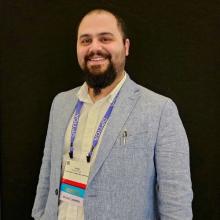
Ismail Erbas, a PhD student in Biomedical Engineering, is advancing research at the intersection of biomedical imaging, artificial intelligence, and hardware design. He is developing a novel smart imaging camera designed to transform image-guided interventions in healthcare. Leveraging the unique strengths of Fluorescence Lifetime Imaging, which offers exceptional sensitivity and specificity for detecting molecular signatures in living tissues, his AI-powered technology is poised to revolutionize fluorescence-guided surgery and drive precision oncology by enabling real-time, in situ quantification of targeted drug delivery.
Precision imaging in oncology is essential for accurately detecting and characterizing tumors non-invasively. It enables surgeons to completely remove malignant tissue while preserving healthy structures and allows clinicians to monitor whether therapies reach their intended targets. By integrating advanced imaging with AI and hardware innovations, precision imaging is driving personalized cancer care and improving patient outcomes. Yet, a major challenge remains: conventional imaging techniques often lack the sensitivity and specificity to distinguish subtle molecular signatures. This limitation hinders accurate tumor detection, complete surgical resection, and effective monitoring of chemotherapy efficacy. To address this, Ismail is developing a “smart camera” capable of instantly performing complex analyses of advanced molecular signatures in deep tissues. By combining cutting-edge single-photon cameras from his collaborators in Switzerland with artificial intelligence models co-designed with IBM, Ismail and his collaborators are creating an innovative system. Deploying these technologies on state-of-the-art edge devices allows the system to deliver immediate feedback to doctors and researchers. “What excites me most,” says Ismail, “is the shift from slow, after-the-fact analysis of these cutting-edge optical imaging techniques to real-time insight. In the operating room, it can guide surgeons. In the lab, it can help scientists watch, in living tissue, exactly how a new cancer drug works. That could accelerate drug development, personalize treatments, and ultimately improve patient outcomes.”
Ismail’s devotion to improving patient outcomes is deeply personal. His father was diagnosed with cancer when Ismail was in high school. After treatments in his home country of Turkey proved ineffective, his family traveled to the United States seeking advanced care. Despite the efforts of leading oncology specialists, his father ultimately lost his battle. This intimate experience with cancer and loss continues to fuel Ismail’s determination to discover effective treatment options for other families.
Ismail began his academic journey at Anadolu University, where he designed and implemented the Hindmarsh Rose Neuron Model on an analog circuit that could reflect the electrical properties of a single neuron. This circuit can be easily applied in an experimental environment if a neural network composed of more than one neuron is desired. He surmised that there could be alternative approaches to observing nerve-cell communication in treating neuro-related diseases such as Alzheimer's disease, epilepsy, and some forms of cancer. Later, during his time at Bogazici University, Ismail conducted psychophysical experiments, translating sensor data from robotic hands into vibrations. By processing sensor data from robotic hands through a Field-Programmable Gate Array (FPGA), Ismail enabled participants to distinguish object hardness and grasp strength in real time, thereby restoring fundamental tactile sensations to those who had lost them. Giving prosthetic users the ability to feel the world around them again is a very satisfying memory for Ismail. His conference paper, 'FPGA Implementation of Multinomial Logistic Regression for Vibrotactile Feedback in a Robotic Hand,' was presented at the International Conference on e-Health and Bioengineering and earned him a Young Researcher Award. He also received recognition as a finalist in the NeurotechEU 3M Thesis Competition. He published multiple articles during this time.
“I was drawn to RPI’s Biomedical Engineering Department because of its distinctive blend of scientific rigor and real-world impact,” says Ismail, “a culture where engineering meets medicine to solve some of healthcare’s most pressing challenges. What truly set RPI apart for me was its reputation not just for innovation, but for nurturing interdisciplinary collaborations that span academia, industry, and the clinic, exactly the environment I saw as essential for advancing the frontiers of medical imaging and technology.” Admiring Professor Xavier Intes as a global leader in biomedical imaging and biophotonics, Ismail came to RPI specifically seeking his mentorship, which is deeply rooted in academic and entrepreneurial worlds, to leverage that potential at the patient’s bedside.
Ismail's contributions have earned significant recognition beyond RPI and the U.S. He was invited to showcase his work at the exclusive, invite-only IBM AI Hardware Forum 2024. His successful work with the Swiss Federal Technology Institute of Lausanne (EPFL) also resulted in an opportunity to present his research at a workshop on their campus last year. Furthermore, his paper on real-time imaging was selected for the Association for Computing Machinery (ACM) Showcase on Kudos, a distinction that also earned him a complimentary ACM membership. Highlighting the direct translational potential of his research, Ismail successfully completed the NSF I-Corps program, earning a $3,000 grant to connect with industry leaders. The clinical relevance of his work is further emphasized by his August 2025 Invited talk at the Fluorescence Guided Surgery Symposium at Harvard Medical School and his presentation at 2025 National Cancer Institute Junior Investigator Meeting. He has also been recognized within our own community, winning second place for his podium presentation at the RPI BME Graduate Research Symposium. Ismail’s extensive publication record and service as a peer reviewer for top-tier journals like NeurIPS further underscore his expertise and leadership in the field. “Every step of this journey has reinforced my belief in the power of collaborative, multidisciplinary research that is anchored in real-world problems, and that is what I hope my work will continue to achieve,” says Ismail. Undoubtedly, his ongoing collaborations with Albany Medical College (molecular probes, surgery), IBM, EPFL, open software developers at UCLA, and clinicians at MGH will make advanced molecular imaging faster, smarter, and far more accessible to patients when and where they need it the most.
After earning his PhD, Ismail intends to launch a biotechnology start-up that builds on his research in advanced imaging and AI-driven diagnostics, leading to personalized treatment decisions for patients worldwide.