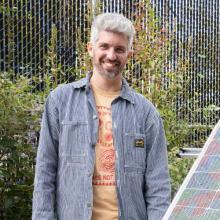
Alex Nathanson describes himself as an “educator, renewable energy accessibility designer, and artist.” This description, however, does not adequately convey the impact of his creative artistry and his ability to empower and engage local community members in making sustained positive changes.
Alex began his academic journey at Simons Rock at Bard College, a small and unique liberal arts college that accelerates student learning by initiating university level programs before graduating high school. He pursued a dual degree in Political Theory and Photography, thriving in a robust community of cross-disciplinary thinkers and creative problem solvers. Post-bachelors, Alex became a multi-media engineer for art institutions, designing and installing electronic, digital, and time-based art installations and the infrastructure that makes them work. His clients included the Guggenheim Museum, the Whitney Museum, and many others.
As an artist, Alex has performed and exhibited his work at museums all over the world. He has collaborated with musicians and artists on a multitude of projects over the past 15 years. The intersection of artistry, creative problem solving, and service presents him with the challenges he enjoys diving into. One such experience, a simple project he undertook to assist a local community garden, changed Alex’s trajectory in a way he did not anticipate. To power an outdoor exhibition of electronic artwork in the garden, he designed a way to provide solar power to the community. His interest in photovoltaic technology grew and he expanded his art practice to focus on creative applications of renewable energy in sound art, kinetic sculpture, wearable technology, digital media, and many other areas. Continuing to integrate art and PV, Alex founded a sustainable energy focused design studio and education platform called Solar Power for Artists, which provides unique educational opportunities for artists, designers, educators, and other non-engineers interested in working with sustainable energy through workshops, a residency program, and online resources. Enhancing his ability to create innovative solutions, he earned a Masters in Integrated Design and Media at NYU Tandon School of Engineering. This culminated in the publication of his first book, “A History of Solar Power Art and Design” published by Routledge in 2021, the first full length interdisciplinary history of creative applications of PV solar power.
Developing education content around solar power became a passion for Alex. He created and delivered curriculum for NYC high schools incorporating solar powered projects, funded through the NYC DoEd Office of Sustainability. He expanded his teaching to include multiple undergraduate and graduate courses as an adjunct professor in Integrated Design and Media at NYU Tandon School of Engineering.
Fundamental to Alex’s philosophy is that community members’ perspectives matter and they must be empowered to play a role in the energy transition. He approaches solutions in a variety of ways. For example, he went to Puerto Rico to help install solar power systems for Hurricane Maria victims. He is also co-project lead, PV system designer, and full stack software developer for Solar Protocol, a global network of small-scale solar powered web servers located in ten countries. While a typical network serves content and manages traffic based on some measure of efficiency like speed, this project experiments with reconfiguring service in relation to available solar resources. The system routes traffic based on which server has the most solar power at a given time. The system has been the subject of multiple exhibitions, presentations, scholarly publications, and journal articles written by various authors.
Alex is currently developing a new system for integrating renewable energy into buildings in large densely populated cities like New York City. His work creates a way for renters to benefit from installing solar panels and batteries. Previously, only property owners had access to tax incentives, discounts, and reduced energy bills. The project combines technical innovation with a clear social purpose. RPI’s Built Ecologies CASE program in Brooklyn is the perfect location for Alex to conduct his PhD Research, which focuses on demand-side energy systems for renters and residents of multifamily buildings, including community dynamics, distributed energy resource accessibility, and household motivations for participation. Recently, NY State passed the Sunny Act, a bill which allows renters to install grid-tied solar panels in their homes for the first time. Alex’s work supports the rollout of this new policy and creates opportunities that go beyond what the Sunny Act provides on its own. True to his cross-disciplinary roots, Alex has been working with Alexandros Tsamis from CASE, Abby Kinchy from STS, and Koushik Kar from Electrical Engineering. Dr. Kinchy is delighted to be part of his committee, saying, “Alex’s research is really ambitious and totally interdisciplinary. It is always fun to be a committee member for a dissertation project like this. There are interesting challenges, like figuring out the best ways to collect data about how people actually engage with technologies that are supposed to conserve energy, deciding how to integrate qualitative observations with quantitative measurements, and then using those findings to inform the design of a new system.”
Alex’s short-term goals are to complete publication of his second book, a collection of DIY solar power art tutorials focused mainly on kinetic sculpture and sound art, and completing his PhD. Post graduation, he plans to continue this important work of democratizing access to renewable energy by working in education, policy advocacy, and with community stake holders.
In his down time Alex loves to hop on the subway to go surfing right of the coast of NY City, where he is often delighted to be joined by a pod of dolphins.